opposite footed fullbacks!
Innovation can scare a lot of people. However, behind the resistance are a select few who choose to explore experimental methods - approaches that can, at times, prove far more fruitful than the existing ones. The saying “results over tradition” is one that every great innovator resonates with.
This week’s innovation article focuses upon a team once again challenging the norms of the fullback role.
Vincent Kompany has, rightfully so, earned plenty of applause this season. His Bayern Munich team currently sit six points clear at the top of the Bundesliga, with nine wins in ten. They also occupy first place in the UEFA Champions League, winning every game so far. Their season record stands at an impressive 16 wins in 17, scoring three or more goals on 13 occasions. Bayern Munich are certainly accustomed to winning, but this season they are doing so with style - and with a change that may once again add a new dynamic to the role of the fullback.
ADAPTING THE ROLE OF FULLBACK
Against Club Brugge in the Champions League, Kompany employed his usual fullbacks in the starting lineup but caught many off guard once the match kicked off: both fullbacks started on the opposite side. Raphaël Guerreiro, known for his devastating left foot, played at right-back, while Konrad Laimer was tasked with playing at left-back. For years, we have seen wingers operate on the opposite side to cut in on their stronger foot, gaining clear tactical advantages. But how do those strengths translate when applied to fullbacks?
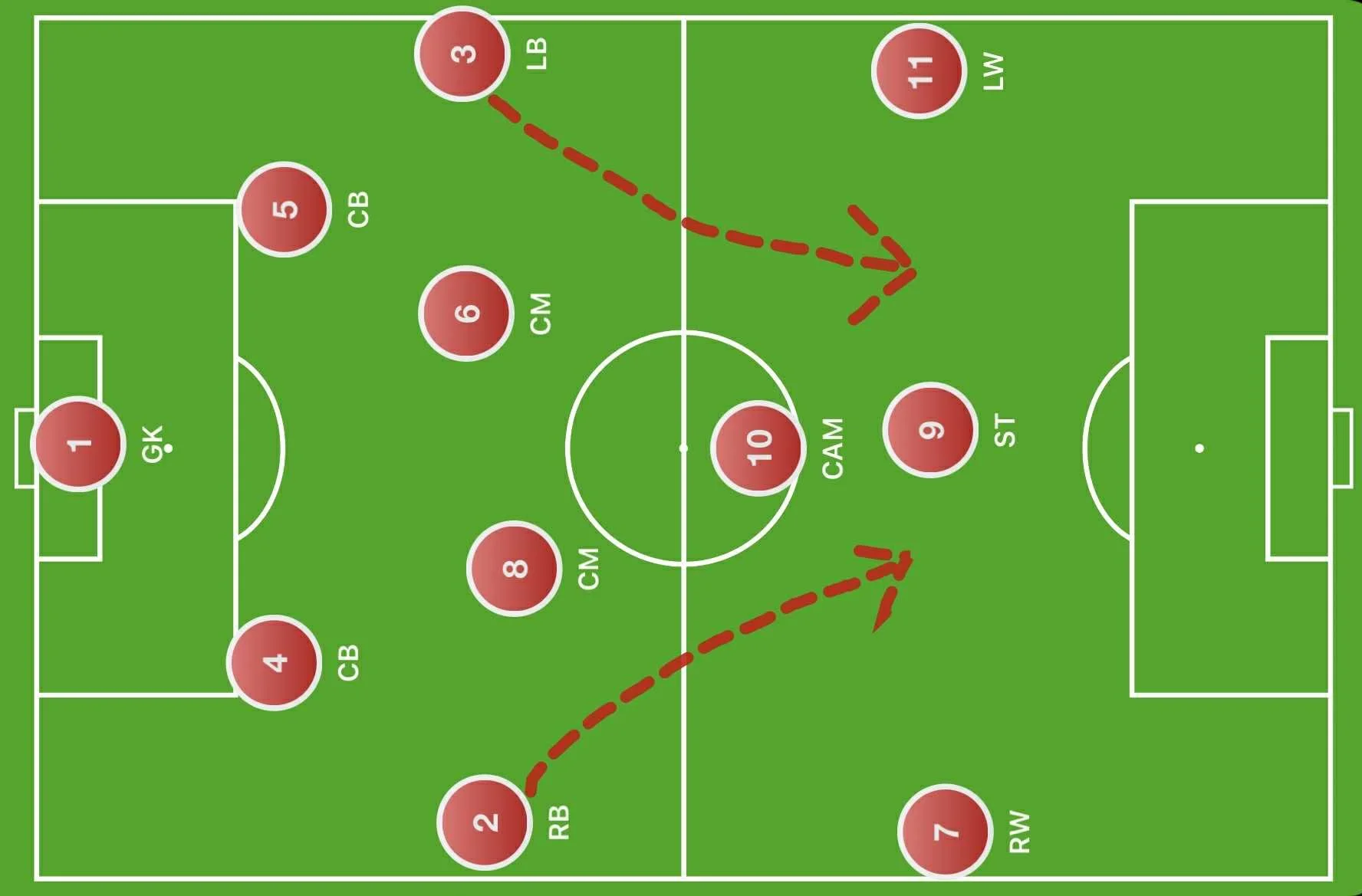
An example of the sort of movements fullbacks coming in on the opposite foot allows.
Seemingly quite well. Laimer has registered six goal contributions from 16 games, while Guerreiro has four from 10. In the match against Club Brugge, Laimer recorded two assists - one of which perfectly showcased the strengths of this tactical shift. Receiving a pass on his back foot on the halfway line, in a typical left-back position with Brugge sitting deep in a full block, Laimer drove infield, carrying the ball onto his stronger right foot from the left side of the pitch. He progressed to the edge of the 18 yard area before laying it off for Díaz, who finished superbly.
Another example appeared three games earlier - this time from Guerreiro against Frankfurt. Picking up a loose ball, he drove across the pitch using his stronger left foot, moving diagonally from right to left, mirroring the movement of an inverted winger. He carried the ball into the final third before laying off for Díaz, who again did the rest. These are two match-defining moments created by fullbacks inverting onto their stronger foot. But is ball-carrying the only benefit this tactical change brings? And does it come at the cost of other parts of a fullback’s game?
wHAT DID THE PROS SAY?
To explore this further, I reached out to several coaching contacts to discuss the principle and uncover the potential pros and cons from a coaching perspective.
The first coach I spoke to told me about Tony Pulis (first long throw-ins, now inverted fullbacks!) and how he used a similar method when protecting a lead and needing to defend crosses more effectively. He explained that playing on the opposite side allows defenders to clear crosses with their stronger foot, leading to more distance, better direction, and more purposeful clearances.
Another coach highlighted how this tactical shift could help when building out against increasingly aggressive pressing systems. Fullbacks generally have more passing options infield, and when playing on their opposite side, they may find a wider passing range with greater confidence - switches of play, disguised passes into central midfield, or more assured retention back into centre-backs or goalkeepers. One clear strength already visible in Kompany’s Bayern is the licence it gives these players to drive inside. Could we start to see an increase in shots from fullbacks? Against low blocks especially, an inverted fullback arriving from deeper positions can find more shooting opportunities.
It all seems positive, right?
Not entirely. A former player I spoke with expressed caution about the defensive implications: “How do these players feel defending on their weaker side?” He explained that he always preferred tackling with his stronger foot, and questioned whether we might see a decline in tackle success, tackle percentage or even crosses blocked when this setup is reversed.
It’s a fascinating development. As with any tactic, it won’t suit every game - but could we start to see more clubs adopting inverted fullbacks on their opposite side? And with the growing variety in fullback profiles, might we finally see young players growing up wanting to be a Gary Neville?
I’d love to hear your coaching thoughts on the benefits and considerations of this role - and whether your team could gain an edge from implementing something similar.
By Sammy Lander.